


1. to eat shawarma today.
2. to be with my family.
3. to go to the grocery.
4. to go home early.
5. to buy a moisturizer.
6. joy, love, and peace.
Bone Health Tips for Every Decade

It may seem like osteoporosis is just a part of aging, but it doesn't have to be. While it's true you lose bone strength and mass as you get older, there are many things you can do to lower your chances of getting osteoporosis. We've spoken with experts and gotten tips for keeping your bones strong during your 20s, 30s, 40s, 50s and 60s.
Though this information is arranged by decade, and some advice—like that on estrogen replacement and bone density tests—definitely applies to that age group, tips on nutrition and exercise are important no matter what your age, and should be followed throughout your life.
In Your 20s
Hip fractures and loss of bone density are likely not on the minds of most 20-somethings, but this is when women need to start working on maintaining the bone strength they have. Marjorie Luckey, MD, medical director at Saint Barnabas Osteoporosis Center in Livingston, New Jersey, says women reach their peak bone mass by their early 20s. This means you have to start working on maintaining what bone strength you have during this decade of your life. Women in their 20s should:
1. Avoid smoking. Smoking cigarettes hampers the work of bone-building cells and increases your risk of developing osteoporosis.
2. Exercise properly. Weight-bearing exercise (this can include simple activities like walking) is strongly recommended throughout your life in order to keep up bone strength. But, as with most things, moderation is key. Nathan Wei, MD, clinical director of the Arthritis and Osteoporosis Center of Maryland, says woman who have extreme exercise habits—to the point where they develop amenorrhea (loss of menstrual cycle)—trick their bodies into thinking they are going into menopause, a major risk factor for osteoporosis.
3. Watch your weight. During your 20s, you may only be concerned with keeping your figure trim, but a healthy body weight should be the goal instead. Being underweight is a high risk factor for osteoporosis. (Underweight is defined as a body mass index (BMI) of less than 18.5 kg/m2.) To find out your BMI, go to WomansDay.com/BMI.
4. Consider a vitamin D supplement. Vitamin D is important for every stage of life because it helps your body absorb calcium, which is very important for bone health. "There is an epidemic of vitamin D deficiency in the U.S.," says Dr. Luckey. "We get a lot less vitamin D than past generations because we are out in the sun less." She advises that women, especially those living in the Northeast, who don't receive as much sunlight as their Southern counterparts, take a vitamin D supplement to reach the recommended 600 to 800 IU per day. Foods such as fatty fish and milk as well as some juices contain vitamin D, but not in large enough doses to get as much as the body needs.
In Your 30s
For many women this is the decade when their focus is on building a career and starting a family. Both of these can have an effect on overall bone health. Women in their 30s should:
1. Keep salt and caffeine in check. Too much of either can promote calcium loss. Lanah J. Brenna, a registered dietician at Reactive Nutrition in Lafayette, Louisiana, advises women to limit their sodium intake to 1,300 mg a day and caffeine to 200 to 300 mg a day to help reduce bone loss.
2. Limit drinking. Excessive alcohol consumption (more than two drinks a day) has been linked to increased risk of hip and other osteoporotic fractures.
3. Consider a calcium supplement. Adult women should get about 1,000 mg of calcium a day. If you're pregnant or nursing, you should bump up your intake to 1,200 mg a day. Dr. Luckey says that most people naturally consume about 300 mg of calcium a day. Adding yogurt or lowfat cheese to your diet will help increase your numbers. "Calcium is listed on nutritional labels as a percentage; to convert that to milligrams, just add a zero," advises Dr. Luckey. If you calculate how much calcium you're getting and you still come up short, add a supplement—most contain between 200 to 600 mg.
4. Learn your family history. Find out if your mother, grandmother, aunts or sisters have (or had) osteoporosis, fractures or any other related health issues. Heredity plays a big part in assessing your risk. If you know you have a family history of osteoporosis, then you can talk to your doctor about what measures (such as earlier bone density testing) you may need to take.
In Your 40s
Hopefully you've established healthy habits during your 20s and 30s. If not, don't underestimate how important this time of your life is. Kick your fight against bone loss up a notch before you reach your high-risk 50s. Women in their 40s should:
1. Add weight training to your exercise routine. You should already be doing at least 30 minutes of physical activity a day, like walking, gardening, golfing, swimming, tennis or dancing. But now's the time to add strength training to your workout routine. Staying active throughout your life helps your bone health by increasing muscle mass, strength, balance and coordination.
2. Consider other health risks. Talk to your doctor about how other health problems such as diabetes, depression and intestinal disorders affect bone health. Also discuss how some medications as well as more intense medical treatments, like chemotherapy, can alter your body's ability to absorb calcium.
3. Figure out your fracture risk. The World Heath Organization has a tool called FRAX that helps you figure out your risk for getting a fracture over the next 10 years. Simply enter your age, height and weight, then answer a few questions about your family history and lifestyle to get recommendations for treatment.
In Your 50s
Your 50s are a time of change—the most important of which is the beginning of menopause. Dr. Luckey says that the 3 to 5 years after menopause are the most important in terms of bone density loss. "Osteoporosis can occur at any age, and for a variety of reasons," says Elizabeth Ricanati, MD, staff physician in the Department of Disease Reversal at Cleveland Clinic. However, she points out that according to the National Osteoporosis Foundation (NOF), over half of the U.S. population develops osteoporosis after the age of 50. Women in their 50s should:
1. Up your vitamin intake. The NOF recommends that adults age 50 and over get 1,200 mg of calcium daily. If you are postmenopausal and not taking hormones, the dosage increases to 1,500 mg a day. It's also recommended that adults 50 and over get more vitamin D (1,000 to 2,000 IU daily).
2. Consider estrogen replacement. Once you go though menopause, your body loses estrogen. Dr. Luckey says that women with high risk factors or signs of osteoporosis often benefit from a low-dose estrogen patch. She sometimes recommends the drug Evista, which "mimics the effect of estrogen" in the bone.
In Your 60s
The decrease of estrogen in your body during your postmenopausal years is a major cause of bone density loss. While some bone loss after menopause may be inevitable, other factors, such as breaking a bone, can put some women at higher risk than others. Women in their 60s should:
1. Get a bone density test. According to Dr. Luckey, all women over 65 should get routine bone density tests. If you're under 65, postmenopausal and have high risk factors, such as a family history of osteoporosis or a broken bone after age 40, it's also recommended that you have regular bone density tests.
2. Protect yourself against falls. Wear shoes with nonslip soles, clear things from the floors that could be easily tripped over, keep hallways and corners well lit, use a stepstool with handrails and be careful with medications that affect your balance or make you drowsy.
3. Talk to your doctor about prescription medication. Depending on how advanced your bone loss is, your doctor may suggest you take medication to prevent further bone loss. Dr. Ricanati explains, "There are different classes of medications to treat osteoporosis, such as the bisphosphonates (Fosamax, Boniva, Actonel and Reclast), SERMs (selective estrogen receptor modulators), estrogen/progestin, parathyroid hormone and others." Dr. Wei also points to a new treatment, denosumab, which is recommended for women who experience side effects from bisphosphonates. As with any prescription drug treatment, there are risks associated with most medications, and the best avenue is always prevention.
[source]

Look Thinner and Younger With These Makeup Tips
An oval face shape is considered to be the perfect face shape, so in order to make your face look thinner and more sculpted, you want to shape your face so that it looks more oval. And best of all, you can do this by using nothing more than foundation and powder. By thinning out the face using the makeup techniques below, you’ll be surprised at what a youthful glow your face will have and what a difference it will all make. Keep reading below to find out how to look thinner and younger in just a few simple steps.
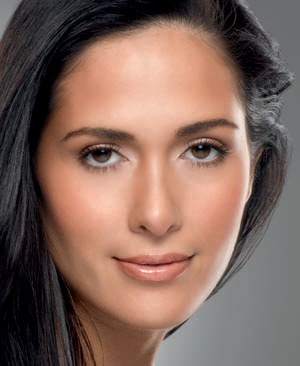
The basic sculpting method involves highlighting and contouring the face. Basically, everything you highlight comes forward and everything you contour stays in the background. So in short, you want to highlight your good features and contour the ones you want to hide. To start, you’ll need three different shades of foundation/powder in three different depth levels:
- The first foundation shade should match your skin exactly.
- The second shade which should be your highlight color, should be one level lighter than the first, preferably with the same undertone.
- The last shade which is your contouring color, should be one level darker than the first, again preferably with the same undertone.
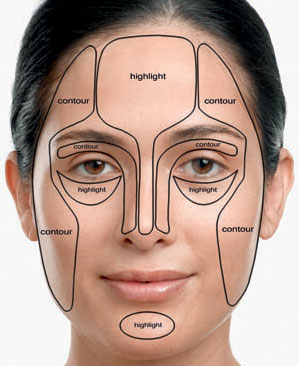 The diagram above should help you with the placement of the foundation. The most important thing to remember is to blend the foundations really well because the blending process is what makes the sculpting method work and look natural.
Step 1:
Apply the first foundation (your true shade) all over your face, blending it well. Start visualizing an oval face. The width of the oval is your eye sockets the height and length of your oval extends from the tip of your forehead to the tip of your chin.
Step 2:
Take the second foundation (your highlight shade) and apply it to the high points inside the oval. This includes your forehead, under the eyes, at the top of the cheekbones and the tip of your chin. So say your face is a little fuller, this will attract the attention to the narrow area to the middle of the face.
Step 3:
Lastly, apply your contour shade (the darkest one) to the areas outside the oval. This includes the the temples, along the hairline, the sides of your cheeks and down the jaw. By deepening these areas, your are making them visually recede and your face to appear more narrow and oval.
Step 4:
Now of course everyone will use different shades according to their skin tones so if you have ivory/beige skin, you’ll contour more than highlight – same goes for really pale skin. If you have bronze/ebony skin you will highlight more than you contour.
Step 5:
Finish up the process by applying powder to your face after you’ve blended all three foundations. For even more dramatic effect, use a different powder to match your three foundations. So use a regular one for your regular foundation, a lighter one where you highlighted and a darker one where you contoured. If you have just one shade of powder, then just use that all over the face. This will help ensure a smooth finish.
Step 6:
Find the perfect blush and then apply it to the apples of your cheeks for a youthful glow. And there you have it; a skinnier, younger looking face just take a few minutes!
Grilled Ham-and-Cheese Sandwiches with Tapenade
To make a gooey grilled cheese sandwich, you need a good melting cheese like Mahón; be sure to choose a young semi-soft variety rather than a hard aged one. Meaty lomo, a newly imported ham made from dry-cured pork loin accented with garlic and paprika, is definitely worth seeking out, though Serrano ham is a very acceptable substitute. Recipe By: Grace Parisi

Serves: 4
Total Time: 25 min
Ingredients
- 2 ounce(s) Spanish green olives, pitted and coarsely chopped (1/4 cup)
- 1 small garlic clove, minced
- 1 tablespoon(s) minced flat-leaf parsley
- 1 teaspoon(s) fresh lemon juice
- Pinch of crushed red pepper
- 1 1/2 teaspoon(s) extra-virgin olive oil, plus more olive oil for brushing
- 8 slice(s) (1/2-inch-thick) peasant bread
 from a 1-pound loaf
 - 6 ounce(s) sliced young Mahón or other young, mildly tangy cow''s-milk cheese, such as Edam or Gouda
- 3 ounce(s) thinly sliced lomo ham or thinly sliced Serrano ham trimmed of all fat
Directions
- In a bowl, combine the olives with the garlic, parsley, lemon juice, crushed red pepper and 1 1/2 teaspoons of olive oil.
- Preheat a grill pan or panini press. Arrange the bread slices on a work surface and brush one side of each slice with olive oil. Turn the oiled sides of the bread face down. Spread the olive tapenade on four slices of the bread. Top with the sliced Mahón cheese and lomo ham and close the sandwiches with the remaining slices of bread. Grill the sandwiches over moderate heat, turning once until the bread is lightly toasted and the cheese is melted, 5 to 6 minutes. Transfer the ham-and-cheese sandwiches to a cutting board, halve and serve at once.

